
Immunotherapy
Immunotherapy is a type of treatment that helps your own immune system find and destroy cancer cells. This type of treatment is now used for many kinds of cancer, including MCC.
The immunotherapy medications used to treat MCC are known as immune checkpoint inhibitors, and they work by making your immune cells stronger against cancer. Keep reading for more details about immunotherapy for MCC.
Immunotherapy for Merkel cell carcinoma (MCC)
The goal of immunotherapy is to boost your immune system so it can better recognize and attack tumor cells. When immunotherapy works, the effects can last a long time.
Immunotherapy is different from chemotherapy. Chemotherapy is usually not the first choice for treating MCC, as it may shrink tumors at first, but the cancer can come back quickly. In one study, about half of the patients had their tumors start growing again just three months after starting chemotherapy, and most had their cancer get worse within ten months.
Immunotherapy, on the other hand, can lead to longer-lasting results for many people with MCC.
Details of immunotherapy
Immunotherapy is a good choice for patients who have advanced or metastatic MCC that has spread to distant locations in the body (stage IV disease), or for patients whose tumor cannot be removed surgically. Immunotherapy should not be used for patients who have a suppressed immune system (such as from other cancers, uncontrolled HIV, or prior organ transplant) or serious autoimmune disease that requires immunosuppressive drugs.
Many immunotherapies are given as infusions at your doctor’s office or cancer center. Infusions are given intravenously (as a needle in a vein) for around 30-90 minutes, every 2-4 weeks, depending on the specific drug.
Side effects
Side effects are possible when the immune system attacks healthy parts of the body. Common side effects of immune checkpoint inhibitors include fatigue, cough, nausea, and itching. Most people feel well while taking these medicines, and they usually do not have hair loss, nausea, vomiting, or infections like with older chemotherapy drugs.
However, sometimes these medicines can cause very serious and life-threatening side effects if the immune system responds by attacking normal parts of the body. These can include colitis (diarrhea), hepatitis (liver injury), pneumonitis (lung inflammation), hormone changes, or nerve complications. It is very important to stay in close communication with
Immune checkpoint inhibitors (ICIs)
Immune checkpoint inhibitors (ICIs) are a type of medicine that helps the immune system fight cancer. Normally, some cancers can “hide” from the immune system by pressing the body’s natural “brakes” (like the PD-1 protein) on immune cells. ICIs work by blocking these brakes, so the cancer can’t hide, and immune cells can attack it better.
There are several ICIs approved for treating advanced Merkel cell carcinoma (MCC). Others are being studied in clinical trials.
Explore some additional information about these medicines:
prescribed by oncologists outside of clinical trials.
This immune checkpoint inhibitor (ICI) was given as an intravenous infusion every three weeks in the outpatient clinic to patients with metastatic MCC who had not received any prior systemic therapy.
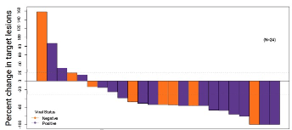
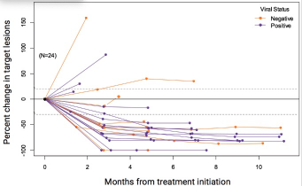
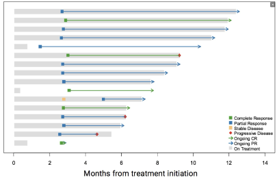
Of those patients, 56% had impressive shrinkage of their tumors. Patients with both virus-positive and virus-negative tumors responded to the treatment. Importantly, 86% of those who initially responded had long-lasting responses, which were strikingly more durable than the chemotherapy responses (Nghiem et al, 2016).
Based on these data, pembrolizumab was listed as a treatment option for patients with metastatic MCC in the 2017 NCCN Guidelines®. The National Comprehensive Cancer Network (NCCN®) publishes annual consensus guidelines for the care of cancers, including MCC, based on expert opinion from all major cancer centers in the United States. It received FDA approval the following year.
In 2019, a follow-up study validated these early findings with encouraging long-term outcomes.
- Pharmaceutical company: Merck
- Description: Antibody against PD-1
- FDA approved: December 19, 2018
Avelumab (brand name Bavencio) was approved by the FDA for the treatment of MCC in 2017 and can be prescribed by oncologists outside of clinical trials.
This is another ICI that works by blocking the PD-1 pathway (it binds to a ligand of PD-1 called PD-L1). Again, it has shown considerable promise in fighting MCC.
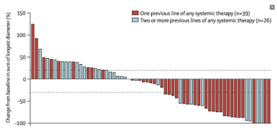
This drug was tested in 88 patients with metastatic MCC who had previously been treated with chemotherapy, and whose tumors had then come back. Therefore, these patients had especially difficult-to-treat tumors. Of the 88 patients treated, 28 (32%) responded with significant tumor shrinkage. Again, the responses appeared to be strikingly more durable than chemotherapy responses: over 80% of patients who initially responded to avelumab had impressively durable responses continuing beyond a year.
It has also been shown to be effective in patients with metastatic disease that has not been previously treated with chemotherapy.
- Pharmaceutical company: EMD Serono/Pfizer
- Description: Antibody against PD-L1
- FDA approved: March 3, 2017
Other ICIs, including nivolumab (brand name Opdivo) and ipilimumab (brand name Yervoy) are also in clinical trials in advanced MCC. However, these are not yet FDA-approved to be used outside of clinical trials, in the United States.
- Ipilimumab (Yervoy)
- Pharmaceutical company: Bristol-Myers Squibb
- Description: Antibody against CTLA-4
- Nivolumab (Opdivo)
- Pharmaceutical company: Bristol-Myers Squibb
- Description: Antibody against PD-1
In addition, there are several other immunotherapy approaches being investigated for MCC in clinical trials, including intra-tumoral injection approaches and infusion of immune cells (T-cells or Natural Killer cells). There is clearly a promising future for immunotherapies in the treatment of MCC.
The following charts provide additional information about immunotherapy and ICIs used for MCC:
The maximum percentage change in tumor size from base-line in response to pembrolizumab:
The rate of change in tumor size; rapid and durable shrinking was observed in most patients:
The 16 patients who had initial response to treatment. Fourteen had confirmed response and 12 of those had a continued response at the end of the trial:
A “Waterfall plot” that depicts the best response of patients who received avelumab after having had traditional chemotherapy:
Patients with the largest tumor shrinkages are on the right, patients with tumors that grew are on the left. Generally speaking, the right of the figure is more red, the left half tending to be more blue. This suggests that having had two or more prior types of chemotherapy may lower chances of response to an immune stimulator.