

Monitoring your MCC
After you finish your initial treatment for MCC, your doctors will want to check on you regularly to see how you’re doing and make sure there are no signs that the cancer has come back or spread. This regular follow-up is called monitoring or surveillance.
It’s important to keep in close contact with your care team after treatment. Your doctor will do regular skin and lymph node exams, and may order blood tests or scans to look for any signs of MCC returning. They will also review your medical history and check for any symptoms or changes that could suggest a recurrence.
The frequency at which you are monitored and get scans, blood tests, or see your doctor, will depend on the risk of your MCC coming back. For example, some patients who have a low risk of recurrence and have spent many years MCC-free may only get check-ups once a year. On the other hand, some patients with a high risk of MCC coming back or with other risk factors like weakened immune systems might need more frequent check-ups, scans, or blood tests, especially for the first couple of years after their diagnosis.
However, everyone who has been treated for MCC should be monitored, no matter their risk level. Regular monitoring helps your doctors find any signs of the cancer coming back early, even if your risk is low. Finding cancer early gives you the best chance for successful treatment and helps prevent it from becoming more serious. By working closely with your care team, you can stay as healthy as possible after treatment.
Types of monitoring
Physical exams
Physical exams involve looking at and feeling your skin, body, and lymph nodes to see if there are any suspicious changes. For example, a physical exam that reveals a new skin lesion, an enlarged lymph node, or an enlarged liver may be a sign that the MCC has come back or spread.
When cancer spreads to other places in the body, away from its original location, it is called metastatic. A lesion (or skin bump) of metastatic MCC may appear as a 1-3 cm skin-colored or red-purple bump that feels firm, is possibly located near the primary lesion, and grows rapidly over a period of 2-4 weeks.
Imaging
Imaging is when doctors use scans to see what’s happening inside your body. Types of imaging include CT (computed tomography) scans, X-rays, MRI (magnetic resonance imaging), PET (positron emission tomography) scans, and other bone scans.
When monitoring for MCC, you may have scans done if the ctDNA blood test or serology blood test indicate a concern, or if something is felt on your physical exam.
Blood tests
Blood tests should also be done to check for signs of recurrence or metastases. These include ctDNA tests, and, in some patients, AMERK serology tests.
Circulating tumor DNA (ctDNA) testing
The ctDNA blood test is a simple blood draw that should first be done around the time of diagnosis, then typically every 3 months during the monitoring phase to check for signs of MCC in the body. Some patients may take this test more often during high-risk periods of time.
The test looks for very small (microscopic) pieces of cancer DNA that have been “shed” from tumor cells and then circulate in the blood stream. These pieces are harmless, and having them circulating in the blood does not mean the cancer is spreading through the blood. However, if these pieces are in the blood, that is a sign that there is Merkel cell carcinoma somewhere in the body.
This test can tell you that MCC is detectable in your body, often several months before an MCC recurrence can be seen on any imaging scans. Patients who get regular ctDNA tests after treatment can avoid extra scans and may find an MCC recurrence sooner.
Your first ctDNA test is simple for you, but quite complicated for the lab that receives your blood and tumor tissue. That’s because they will actually be designing a personalized test for you. They do this by sequencing some DNA from your tumor (they will get this from the pathology lab where your biopsy was sent) and also from your blood cells. The DNA sequences are then compared in order to create a test that is customized to detect your specific tumor.
You may have to wait 4-5 weeks for the result when you take your first ctDNA test, because it takes time to create this personalized test for you. But once it’s created, it can be used for all your tests in the future. Results from your future tests will come back in 1-3 weeks.
- A negative test is 0.00 MTM/mL
- A positive test is any result greater than 0.00 MTM/mL
- Results less than 1.00 MTM/mL mean that MCC is less likely (~20%) to be detected on a scan within 90 days
- Results between 1.00 to 10.00 MTM/mL mean there is a ~50% chance of finding a tumor on a scan within 90 days
- Results greater than 10.00 MTM/mL mean there is a ~70% chance of finding a tumor on a scan within 90 days, and ~90% chance of finding one within 180 days
What this means for you: If the result is above 1.00 MTM/mL when there is no obvious MCC on exam, your medical team should discuss whether it is time to do a scan to evaluate for MCC recurrence. If the result is between 0.01 and 1.00 MTM/mL, it may make sense to repeat the blood test within a few weeks to determine if the level has increased and if a scan would be useful at that time.
MCPyV serology testing (“AMERK” test)
Patients should have already taken a type of blood test called a serology test, or oncoprotein antibody test, around the time of diagnosis. This test looks for special antibodies in the blood that appear in some people as a reaction against Merkel cell polyomavirus (MCPyV), the virus that causes most MCC tumors. The blood test can also be used for monitoring, but only for patients who had a positive first serology test. <Find more information related to the initial serology test>
Patients who had a positive serology test at the time of diagnosis should continue to get repeat serology tests every 3 months to check for signs of MCC recurrence.
- A person’s antibody levels usually drop by about 90% in the first year after treatment and keep going down; but if the cancer returns, the levels go up quickly again. You will continue to take serology tests over time to be alerted if your levels rise.
- Importantly, it is the percent change in your antibody levels, not the actual value, that indicates whether you may be having a recurrence. Increases in your antibody levels greater than 30% are concerning for a recurrence and your doctor should be notified promptly.
- Depending on the stage of the disease and other risk factors, your medical team may decide to reduce the frequency of testing, or discontinue testing, after 3-5 years of monitoring.
If your first serology test was negative (and this was done within a few months of diagnosis), it means you do not make these antibodies. Because of this, you cannot be tested for antibodies as a part of your monitoring, because you will not make these antibodies even if your MCC comes back.
- You won’t need any additional serology blood tests. You will, however, need to be monitored closely. Not having antibodies means you have a higher risk of recurrence, so you’ll need imaging scans or blood tests for ctDNA, as described above.
An introductory video on YouTube
We created a short video on YouTube <video overview of the Merkel virus serology test> that explains how the Merkel virus serology test (called AMERK) works and how it helps doctors monitor MCC patients.
Please review the test requirements: https://testguide.labmed.uw.edu/public/view/AMERK
Ordering the test: Please complete the AMERK Requisition (link below) form in its entirety, including the address to send results to the ordering provider. Please include the clearly written name and NPI number of the ordering physician; this information is required to complete testing. Please ensure there are two patient identifiers on the form. The most common forms of patient ID are name and date of birth.
Receiving results: Test results will be received by the ordering physician between 2-3 weeks from the testing date. The patient should receive results through the ordering physician’s care team. Contact information for the ordering physician should be added under “send report to” on the AMERK Requisition form. Please enter contact information for the ordering physician’s department that handles results. All information must be clearly legible.
Questions: Contact the Client Support Services at 206-520-4600 or [email protected].
Download the form that will allow any medical facility to order the Merkel virus serology test.
In 2010, Dr. Kelly Paulson and other researchers reported that oncoprotein antibodies increase and decrease with the amount of MCC present in a patient. Since that time, funded by the US National Cancer Institute, our team at merkelcell.org has followed several hundred patients to determine how useful this test is in the “real world”. We have concluded that obtaining this test at baseline is useful for all MCC patients as it helps determine how they should be followed over time.
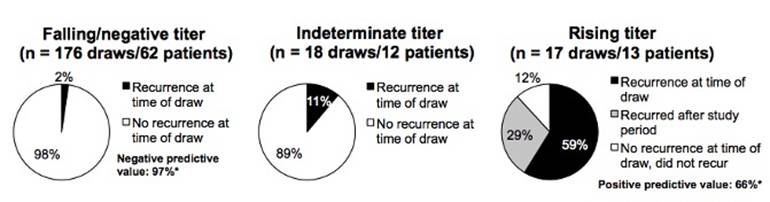
Below are graphs from our antibody study that summarize what it means when the test is falling, indeterminate (stable), or rising.
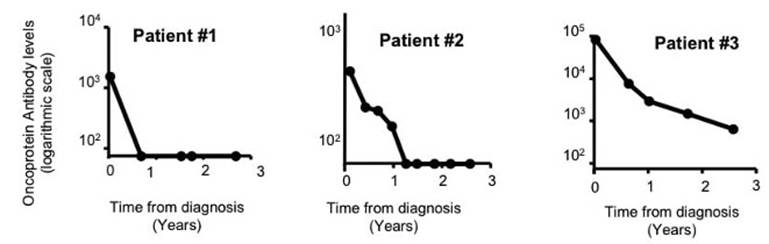
Below are graphs from three individual patients who did not recur and who had falling titers of oncoprotein antibodies.
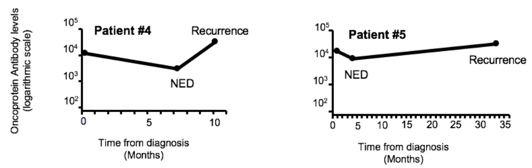
Below are graphs from two individual patients who did experience a recurrence of their MCC and who had rising titers of oncoprotein antibodies.
- How fast should oncoprotein antibody titers be falling?
After treatment is complete, oncoprotein antibody titers typically fall by half every 3 months for patients whose MCC is not returning (link to Gunnell: https://pubmed.ncbi.nlm.nih.gov/40928768/). - Among patients who made oncoprotein antibodies at diagnosis, what does a falling (or newly negative) titer mean?
Among patients whose Merkel virus antibody level falls or becomes negative on a blood test, the chance that they will not have a recurrence in the next 3 months is over 99%. - If the oncoprotein antibody titer is rising, how likely is it that there is a recurrence?
If a patient has a single rising antibody level, the risk of their cancer coming back in the next 3 months was 36%. By one year, the risk was 58% and by two years the risk was 68% (link to Gunnell: https://pubmed.ncbi.nlm.nih.gov/40928768/) - What does it mean if a patient had an increase in oncoprotein antibody titer and their scan does not show any obvious disease?
It is common for the antibody level to rise before the cancer can be detected by scan. On average, the blood test became positive 3.7 months before the cancer was detected on exam or by scan. 90% of patients who have an increase in their antibody level did develop an MCC recurrence by 14 months after the blood test that showed the increase. - Is it better to have a higher titer of Merkel virus oncoprotein antibodies?
A higher titer of oncoprotein antibody is not directly associated with any change in the chances of beating the cancer. One cannot compare the values across patients because the antibody titers are only meaningful if tracked over time for an individual patient. Percent changes in antibody titers are more important than the specific titer value itself. - What does a borderline oncoprotein antibody result mean?
Patients with a borderline result (a titer of 75-150) for the oncoprotein antibody test at a time when MCC was present may or may not make antibodies to the oncoprotein. If a repeat test a few months after treatment then becomes negative, this strongly suggests the patient did make these antibodies when the cancer was present and that the test will be useful in that patient to detect recurrences.
If it turns out that the serology test is not useful for a patient (because they don’t make antibodies), how will the disease be monitored?
If a patient does not make oncoprotein antibodies when they have the disease, then the serology test won’t be helpful for monitoring. However, the patient should continue regular clinical visits and may benefit from use of the ctDNA test.