
Recurrence
What is recurrence?
Cancer that comes back after treatment is called a recurrence. If you have completed treatment and there are no more signs of cancer in your system (the disease is undetectable on exam or scans), but later Merkel cell carcinoma (MCC) is found in your body, that is considered a recurrence of MCC—even if it’s in the same spot as before.
There are three aspects related to recurrence that will be discussed in this section:
- Recurrence – cancer that comes back
- Risk of Recurrence – the percent chance the cancer may come back
- Recurrence-free survival – how long patients live without their cancer returning
Who is at risk for recurrence?
All patients have some risk that their cancer could return, but not every patient will have a recurrence. On average, MCC will recur in 40% of patients. The chance that a patient’s MCC will come back depends on many factors, such as:
- The stage of your MCC when you were diagnosed
- Your age
- Where your original cancer was located
- The treatments you had and when you had them
- How your cancer responded to those treatments
- Your overall health and other medical conditions
All of these things can affect your risk of recurrence.
Why is risk important?
Your doctor will think about your personal risk when helping you make a treatment plan. For example, patients with a very low risk of recurrence may not need some treatments that are recommended for higher-risk patients. <Learn more about treatment decisions>
Knowing a patient’s estimated risk of recurrence also helps doctors determine how closely to follow them for continued check-ups after their initial MCC treatment. The goal of these monitoring visits is to catch any sign of a recurrence early. Patients with a higher risk of recurrence may have more frequent monitoring visits. <Learn more about monitoring>
What makes recurrence more likely?
Some things that can make recurrence more likely include having a virus-negative tumor, a weakened immune system, a large tumor (>2 cm), or other health conditions. It’s important to talk with your doctor about what these risk factors mean for you, and work with them to make a monitoring plan to watch for any signs that the cancer might come back. Staying informed, having regular check-ups, and using blood surveillance tests can help you stay prepared.
Signs and symptoms of a recurrence
Sometimes, new symptoms tell you or your doctor that MCC has grown back. These may include a new bump on your skin or a new swollen lymph node. If you find a new bump or swollen lymph node, tell your doctor right away so they can schedule a biopsy to see if it is MCC or something else.
Other times, there are no obvious physical symptoms or signs of a recurrence that you can see or feel. That’s why doctors will continue checking you after treatment, using scans and blood tests. This is called monitoring. <Learn more about monitoring>
Evaluating risk of recurrence for MCC
Your “risk of recurrence” is the chance your cancer will come back in the future.
Doctors use information from other patients to help estimate your risk. They look at patients whose MCC is similar to yours to see how often their cancer came back and how long it took to come back. This is called “recurrence-free survival” data. By studying these patterns, doctors can better predict how your MCC might act.
From this data, we know that:
- Risk depends a lot on the stage of cancer when it was first found and treated. The higher the stage, the greater the risk that MCC will come back. <Understand the stages of MCC>
- Most recurrences happen within the first 3 years after treatment. About 95% of recurrences happen during this time. After 3 years, the risk is much lower.
The deep dive below shows how cancer stage affects the chance of recurrence in MCC.
Doctors and patients may also explore the MCC Recurrence Risk Calculator to estimate their personal risk based on details unique to each case.
Researchers use a type of graph called a “Kaplan-Meier curve” to show how risk of recurrence changes over time. These graphs can be very helpful in determining how closely a patient needs to be followed. For example, after 2-3 years, the frequency of visits, blood tests, and scans can typically start to decrease, because risk is highest in the first few years.
Measuring risk of recurrence
To measure risk of recurrence, researchers track the “recurrence-free survival” of patients at different time points after treatment. Recurrence-free survival is the length of time between treatment ending and cancer coming back, or the time to death from a non-MCC related cause, whichever comes first. Mapping these points out on a Kaplan-Meier curve shows how many people are still living without an MCC recurrence at different times.
Recurrence-free survival varies by the stage of the cancer at diagnosis. About 80% of all MCC recurrences show up within the first two years after diagnosis.
Mapping out recurrence-free survival
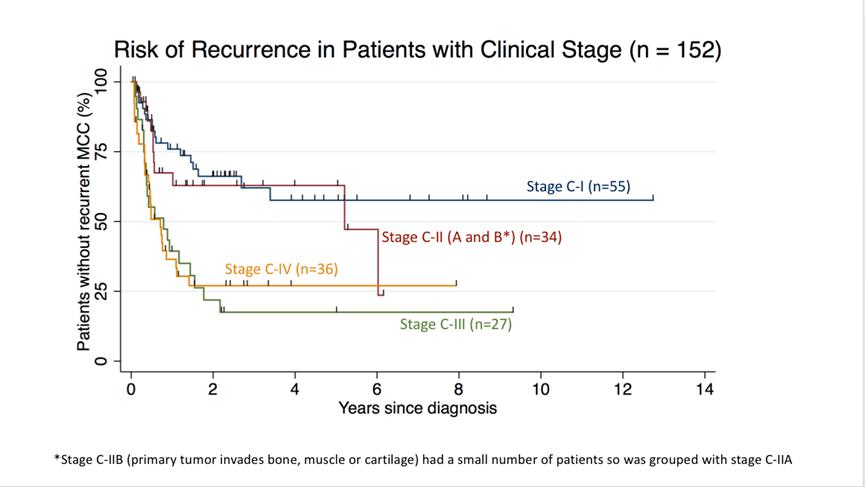
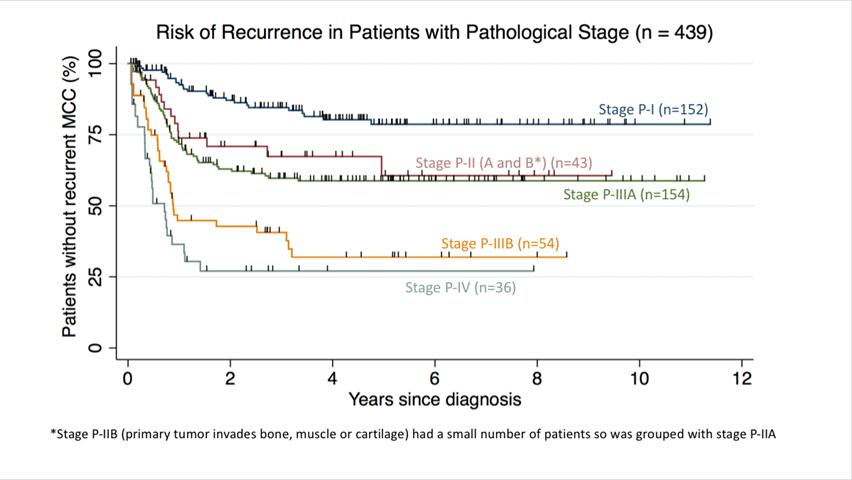
The graphs below show the recurrence-free survival of patients based on their pathological or clinical stage.
Kaplan-Meier curves can be hard to understand, but the important part is that they can help us know how often and when different events happen over time. In this case, mapping recurrence-free survival shows the chance that MCC has not recurred at a given time. The percentages on the left Y-axis show the amount of people living without MCC recurrence, and the amount of time that has passed is shown on the bottom X-axis.
Each tick mark on a curve indicates a patient who was removed from the analysis at that time point (with time going across the bottom X-axis). This is called “censoring”. When a patient is “censored”, it means they are no longer included in the data to the right of that point because they either had a recurrence, died from a non-MCC cause, or there was no more follow-up data available for the patient.
Below, we see that the percentage of patients living without an MCC recurrence is higher the closer they are to diagnosis and begins to drop within the first two years. Although this general trend is the same across the stages, there are differences in how steep the lines are, because recurrences happen more quickly and more often in higher stage MCC.
Risk by pathological stage: Graph shows 439 patients who were enrolled in the Seattle-based cohort through January 2018. The ‘n’ numbers show the amount of patients with each pathological stage. Pathological stage IIB was combined with pathological stage IIA because of the low number of patients (small sample size). Stage was determined using the AJCC 8th Edition staging system.
Risk by clinical stage: Graph shows 152 patients who were enrolled in the Seattle-based cohort through January 2018. The ‘n’ numbers show the amount of patients with each clinical stage. Clinical stage IIB was combined with clinical stage IIA because of the low number of patients (small sample size). Stage was determined using the AJCC 8th Edition staging system.