
Survival outlook
Survival and disease recurrence are two important ways doctors understand and measure what might happen after someone is diagnosed with Merkel cell carcinoma (MCC).
- Recurrence means when the cancer comes back
- MCC-specific survival refers to how long you may live following an MCC and your likelihood of not dying from this cancer
It is important to know that survival expectations are not the same for everyone. Your healthcare team will help you plan for what to expect, based on your own specific tumor characteristics and risk factors.
Stage at diagnosis
How long a person lives after being diagnosed with MCC depends a lot on the stage of the cancer when it was found. Doctors will tell you the stage of your cancer when you are first diagnosed, by looking at many factors such as the size of the tumor and where the cancer is located. Knowing this can give you a better idea of what’s to come.
People whose cancer is only in the skin or lymph nodes (local or nodal disease) usually live longer than those whose cancer has spread to other parts of the body (distant/metastatic disease). <Learn about the stages of MCC>
Personal risk factors
Survival expectations also depend on a patient’s individual risk factors.
People who have weaker immune systems, especially problems with their “T lymphocytes” (an important type of immune cells), have a lower survival outlook than people with healthy immune systems. Some examples of these immune problems are people who have HIV/AIDS, people who regularly take immune suppressive drugs (often prescribed after organ transplantation), or people who have certain immune cancers like chronic lymphocytic leukemia (CLL).
Having these kinds of immune suppression also make a person more likely to get MCC in the first place. <Learn more about MCC and the immune system>
Researchers use a type of graph called a “Kaplan-Meier curve” to show how survival rates change over time. These graphs can be helpful to see the trends of how long people can live with MCC.
Measuring survival for MCC
To measure survival, researchers track the “MCC-specific survival” of patients at different time points after treatment. MCC-specific survival is the amount of time between a patient’s diagnosis and their death from MCC.
The stage of the cancer at diagnosis is a key factor in a patient’s survival. In general, about 1 in 3 people will lose their battle to MCC. Most deaths from MCC happen in the first three years after diagnosis, but the amount of time varies by stage, as shown below.
MCC-specific survival, by stage
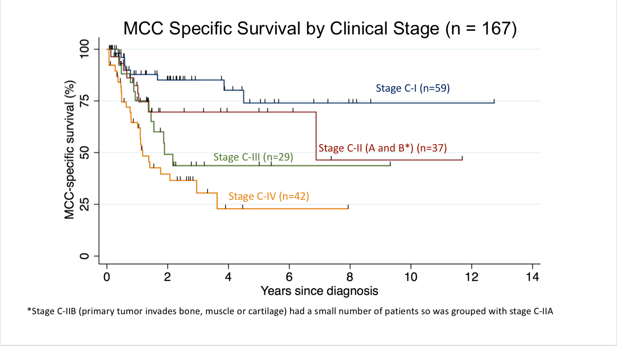
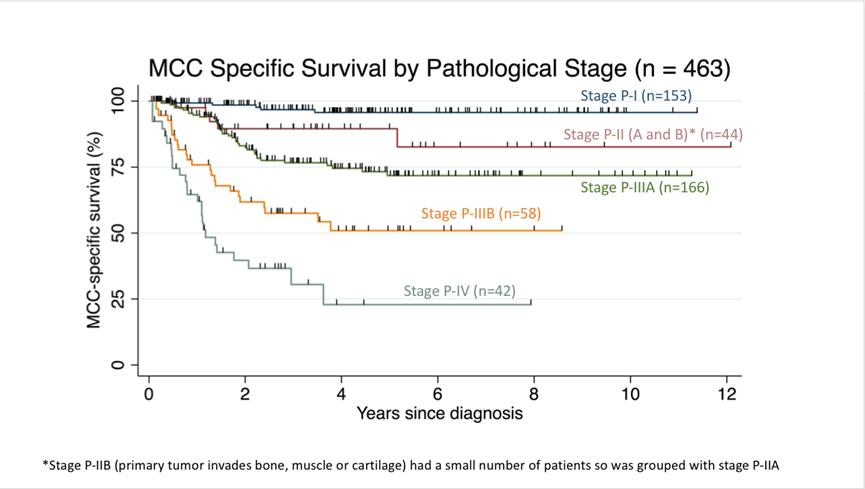
The graphs below show how many people are still living with MCC recurrence at different times, based on their pathological or clinical stage. Here, mapping MCC-specific survival shows the chance of not dying from MCC. The percentages on the left Y-axis show the amount of people still living, and the X-axis at the bottom shows the amount of time that has passed.
Kaplan-Meier curves can be hard to understand, but the important part is that they can help us know how often and when different events happen over time. Each tick mark on a curve indicates a patient who was removed from the analysis at that time point (with time going across the bottom X-axis). This is called “censoring”. When a patient is “censored”, it means they are no longer included in the data to the right of that point. In this case, they are removed either because they died from MCC, or because there was no more follow-up data available for the patient.
Below, we see that all patients with MCC are living at the beginning, shortly after diagnosis, and then the percentages of patients who are living with MCC begin to change at different rates based on the different stages.
MCC-specific survival by pathological stage: Graph shows 463 patients who were enrolled in the Seattle-based cohort through January 2018. The ‘n’ numbers show the amount of patients with each pathological stage. Pathological stage IIB was combined with pathological stage IIA because of the low number of patients (small sample size). Stage was determined using the AJCC 8th Edition staging system.
MCC-specific survival by clinical stage: Graph shows 167 patients who were enrolled in the Seattle-based cohort through January 2018. The ‘n’ numbers show the amount of patients with each clinical stage. Clinical stage IIB was combined with clinical stage IIA because of the low number of patients (small sample size). Stage was determined using the AJCC 8th Edition staging system.